How to Choose the Best Hotel Bed Linen
A B2B buyer's guide to hotel bed linen: cotton type, staple length, thread count, weave, GSM, sizing, and commercial durability.
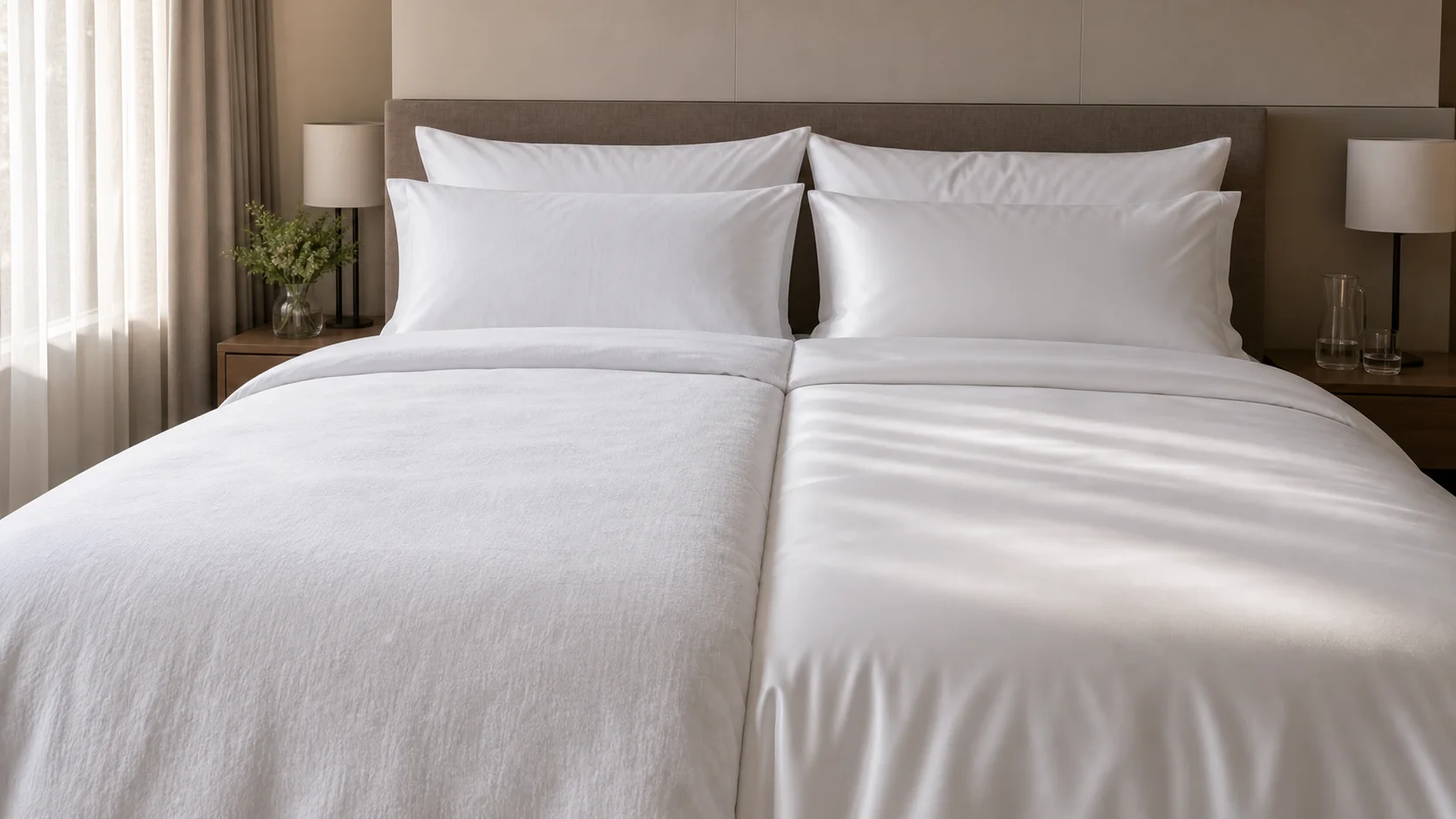
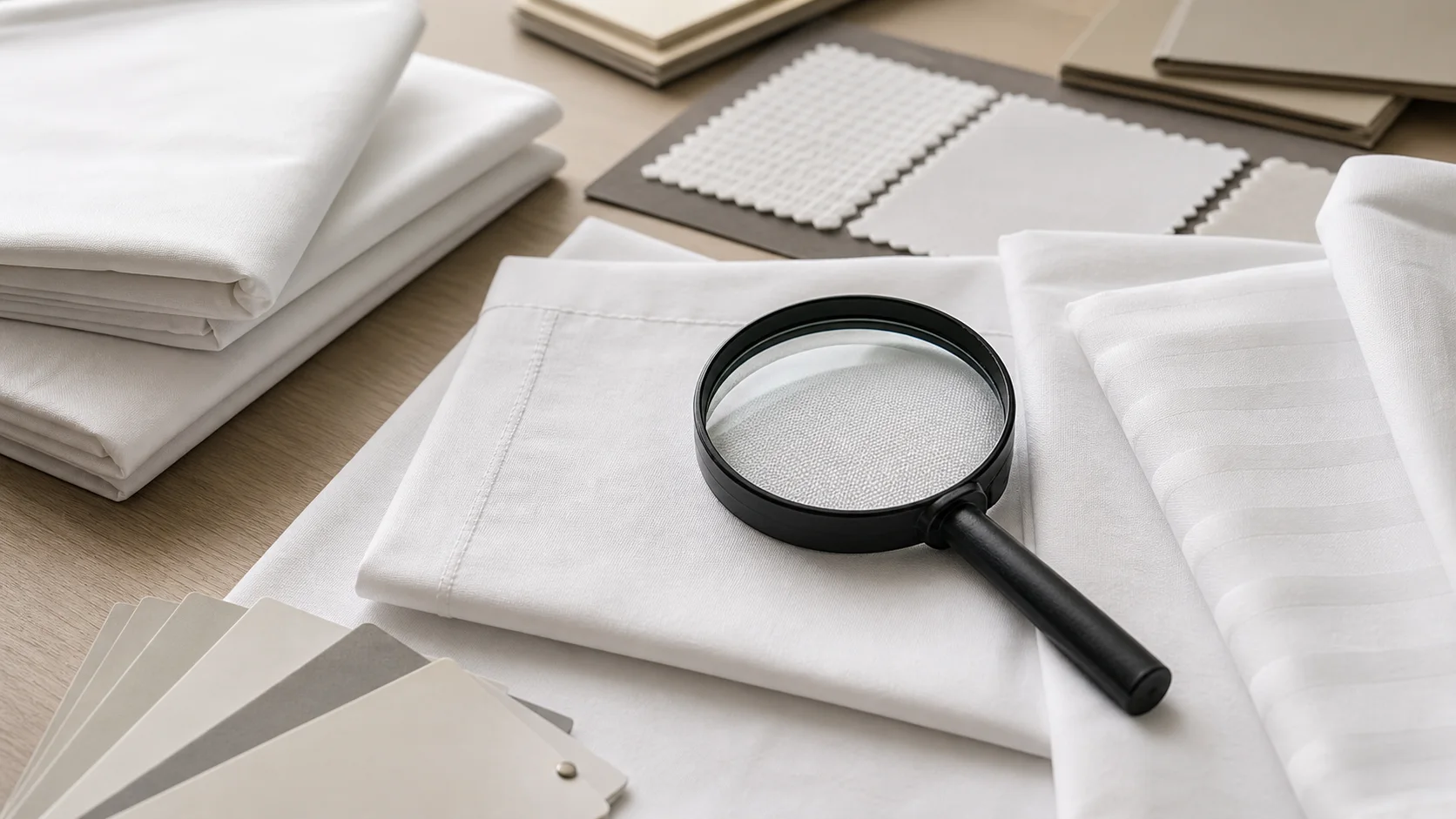
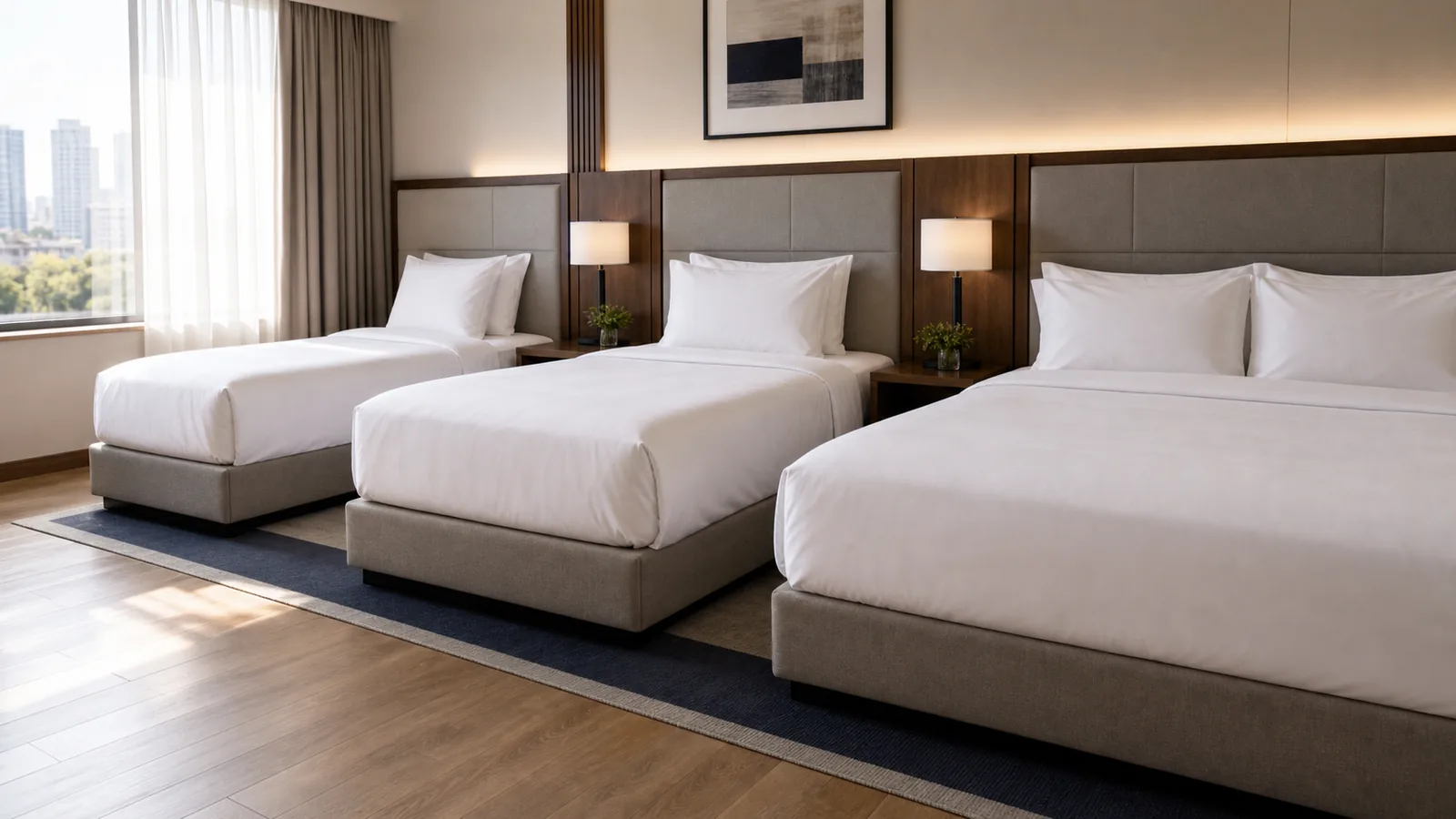
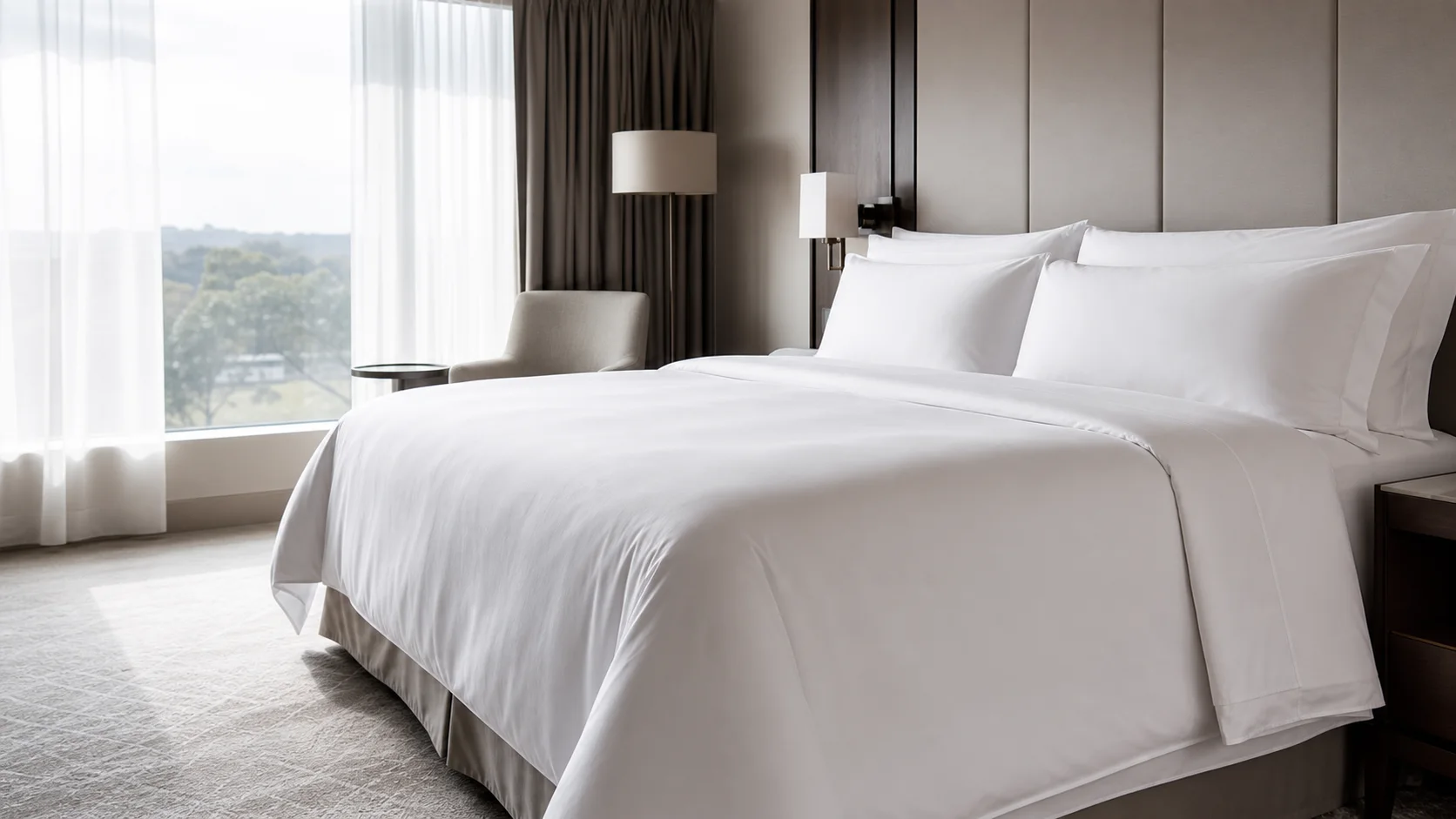
Materials and operations, shown together.
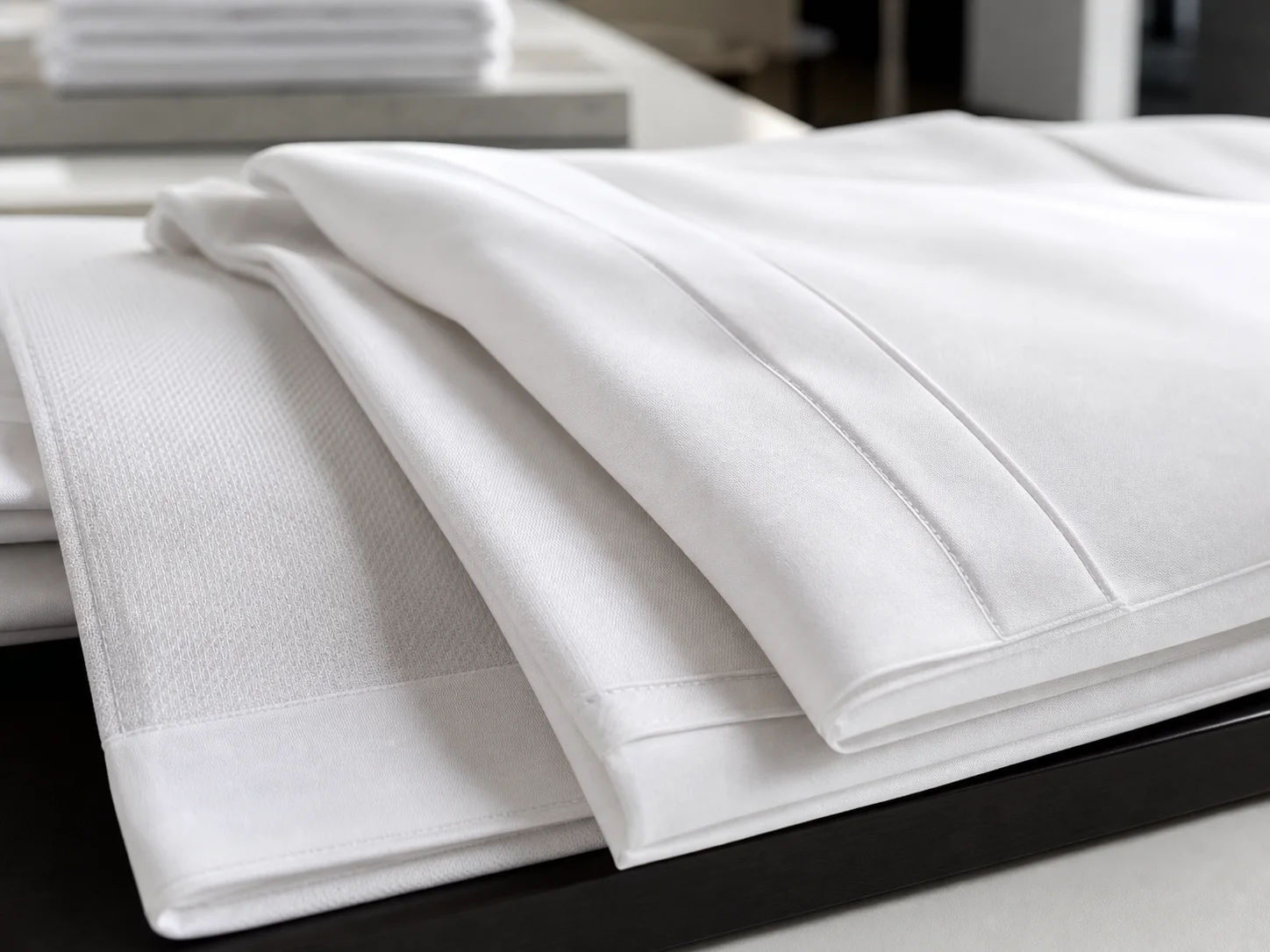
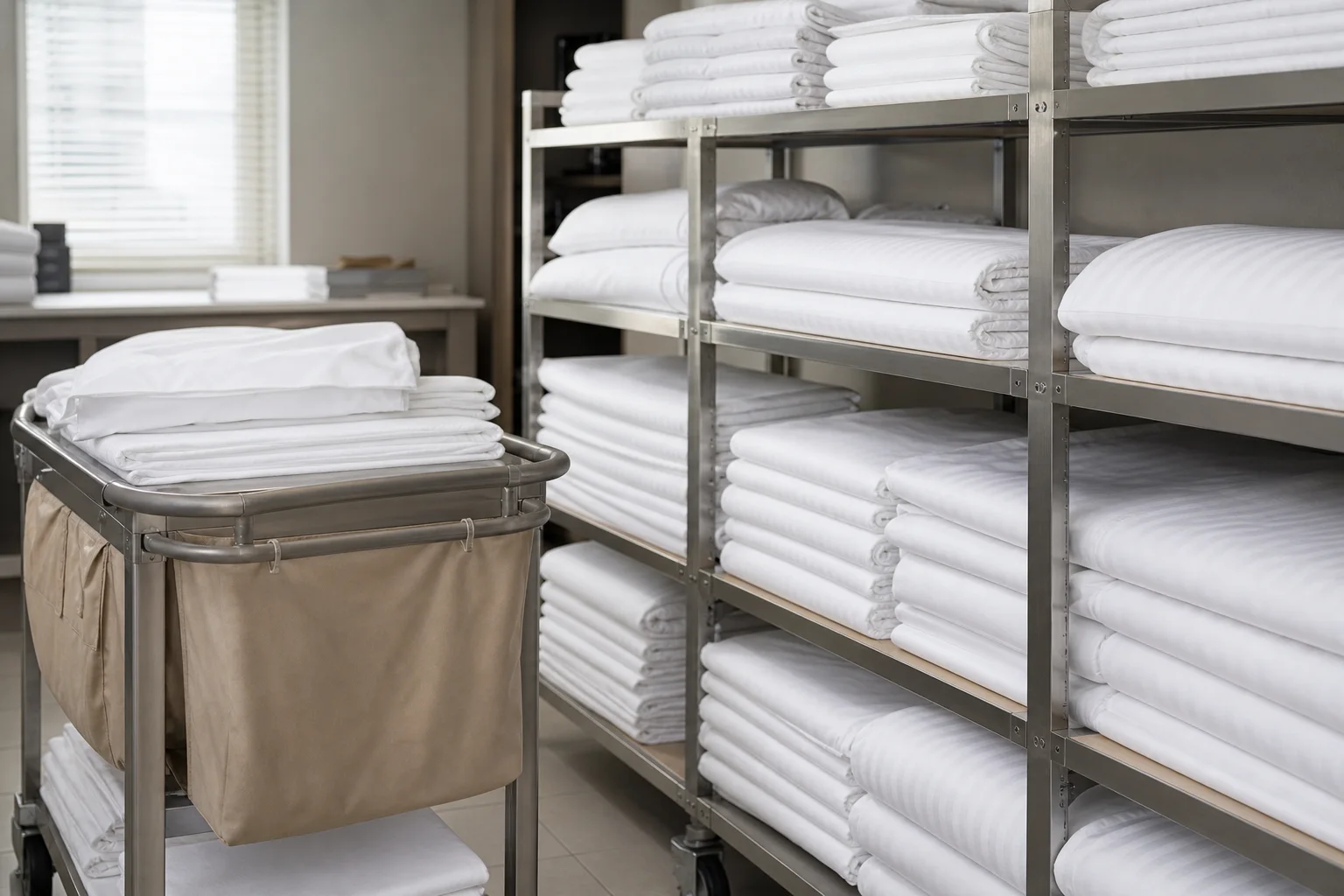
Product detail and back-of-house context help connect each specification choice to how the item looks, launders, stores, or survives service.
How to Choose the Best Hotel Bed Linen: Cotton, Thread Count, and Weave
Few things shape a guest’s impression of a room as quietly, or as powerfully, as the sheets they sleep in. Crisp, well-finished bed linen signals quality before a guest unpacks a single bag. Thin, pilled, or graying sheets undo the work of an entire renovation. The problem for procurement teams is that “premium” is a fuzzy word. Vendors toss around Egyptian cotton, high thread count, and luxury weave with almost no agreement on what those terms actually mean.
This is a buyer’s primer on how to specify hotel bed linen that looks right on opening day and survives years of industrial laundering. We’ll cover cotton types and why staple length matters, the basics of thread count and weave, weight and sizing, white-on-white design options, durability for commercial laundries, and how your property’s star rating should drive the spec.
Key takeaways
- Staple length beats thread count. Long-staple and extra-long-staple cotton (Egyptian, Pima/Supima) produces stronger, softer, longer-lasting sheets than a high thread count made from short fibers.
- Match the weave to the experience you want. Percale feels crisp and cool; sateen feels smooth and silky. Both work for hotels, so choose by brand positioning, not price alone.
- Specify for the laundry, not just the bedroom. Commercial bed linen has to survive 150-250+ industrial wash cycles, so weight (GSM), finishing, and construction matter as much as feel.
- Thread count has a ceiling of usefulness. Past roughly 300-600 for most weaves, higher numbers are marketing, not quality.
- Let your star rating set the floor. A budget property and a luxury flagship need different specs. Every tier still benefits from durable, well-finished cotton.
Why cotton type matters more than the number on the package
Cotton is the default fiber for hospitality bedding because it’s breathable, absorbent, durable, and easy to launder and sanitize. But “cotton” covers a wide range of quality, and the single biggest driver of that quality is staple length: the length of the individual cotton fibers before they’re spun into yarn.
Longer fibers spin into finer, stronger, smoother yarns with fewer loose ends. That means fewer weak points, less pilling, a softer hand, and much better resistance to the mechanical stress of commercial washing. Shorter fibers produce yarns with more exposed ends that pill, weaken, and gray faster. This is why a sheet made from genuine long-staple cotton at a moderate thread count will routinely outlast (and outfeel) a cheaper sheet with a higher number on the label.
Here are the cotton categories you’ll encounter most often:
- Upland cotton. The most common cotton worldwide, with short-to-medium staple length. Affordable and serviceable. It suits budget and mid-tier properties when it’s woven well, but it pills and softens unevenly faster than premium grades.
- Pima / Supima cotton. An extra-long-staple (ELS) cotton grown mostly in the United States. “Supima” is a certification mark guaranteeing genuine American Pima. Strong, soft, and good at holding color. A reliable workhorse for upscale hotels.
- Egyptian cotton. A premium ELS cotton when it’s genuinely grown in Egypt’s Nile region. Prized for long fibers, durability, and a luxurious hand. One caveat: the term gets abused constantly, so verify origin and staple length rather than trusting the label.
- Cotton-polyester blends. Usually 50/50 or 60/40, engineered for durability, wrinkle resistance, faster drying, and lower cost. You give up some of the natural, breathable feel. Popular for high-turnover, budget-conscious operations.
How to read a cotton spec sheet
When you request samples, ask the supplier three questions that cut straight to quality: What is the staple length (in millimeters or graded as short/long/extra-long)? What is the yarn count (finer single-ply yarns generally feel better than coarse or doubled yarns padded to inflate thread count)? And is the fiber combed (combing removes short fibers and impurities, yielding a smoother, stronger yarn)? Honest suppliers answer these readily.
Cotton type comparison table
| Cotton type | Staple length | Feel | Durability for commercial use | Relative cost | Best fit |
|---|---|---|---|---|---|
| Upland cotton | Short-medium | Soft, everyday | Moderate | $ | Budget & economy properties |
| Cotton-poly blend (50/50-60/40) | Varies | Smooth, less breathable | High (wrinkle & wear resistant) | $ | High-turnover, cost-focused operations |
| Pima / Supima (ELS) | Extra-long | Soft, smooth, resilient | High | $$-$$$ | Upscale & premium hotels |
| Egyptian cotton (genuine ELS) | Extra-long | Luxurious, fine | High (when authentic) | $$$-$$$$ | Luxury & flagship properties |
Costs are relative tiers, not fixed prices; actual pricing depends on construction, finishing, order volume, and sourcing.
Thread count basics (and why it’s only part of the story)
Thread count is the number of threads, warp (vertical) plus weft (horizontal), woven into one square inch of fabric. The logic is intuitive: more threads, denser and smoother fabric. Up to a point, it holds true. For most hotel bed linen, a thread count in the 200-400 range gives you a solid balance of durability and comfort, while genuine luxury sateens may reach 500-600.
The catch is that thread count is easy to game. Manufacturers inflate the number by using multi-ply yarns (counting a 2-ply thread as two) or by packing in thin, low-quality fibers that look impressive on paper and wear out fast. A 1,000-thread-count sheet made from short-staple, multi-ply yarn is often worse than a 300-thread-count sheet of single-ply long-staple cotton. The fiber and yarn behind the number matter more than the number itself.
For procurement purposes, treat thread count as a supporting spec, not a headline. Anchor your decision on cotton type and weave, then use thread count to fine-tune within that choice. We dig into the inflated claims and how to spot them in our companion piece on thread-count-myths.
Weave overview: percale vs. sateen
The weave, meaning how the warp and weft threads interlace, determines how a sheet feels, drapes, and breathes, often more than thread count does. Two weaves dominate hospitality:
- Percale. A simple one-over-one-under (plain) weave. The result is matte, crisp, cool, and breathable, with that fresh-hotel-sheet snap. It’s durable and launders well, which makes it a hospitality staple. Some guests find it stiff until it’s broken in.
- Sateen. A weave where each warp thread floats over several weft threads, usually three or four. That creates a smooth, lightly lustrous surface with a heavier, draping hand. It feels warmer and more luxurious, though the exposed floats can be a bit more prone to snagging over time.
Neither one is objectively better. The right choice depends on your climate, brand positioning, and the guest experience you want to deliver. Many groups specify crisp percale for a clean, classic feel and reserve silky sateen for suites or luxury tiers. For a full breakdown of how each weave performs in commercial settings, see percale-vs-sateen-hotel-sheets.
GSM and fabric weight
GSM (grams per square meter) measures the weight and density of the fabric. Heavier fabrics generally feel more substantial and tend to last longer under repeated washing, while lighter fabrics feel cooler and dry faster. For hotel bed sheets, typical weights fall in a broad mid-range. The practical rule is simple: very light sheets often signal thin, short-lived fabric, while very heavy sheets cost more to launder and dry. Ask suppliers for the GSM alongside thread count and cotton type to get the full picture of what you’re buying. (Weight matters even more for towels, which we cover in our hotel-towel-gsm-buying-guide.)
Sizing, fitted vs. flat, and the full bedding set
Bed linen sizing has to match your mattress dimensions precisely, and that includes mattress depth, which has crept upward as plush, pillow-top mattresses became standard. A fitted sheet that’s too shallow will pop off corners and create housekeeping headaches; one too deep will bunch. Always confirm the pocket depth (in inches and centimeters) against your actual mattresses, and remember that mattress toppers add depth too.
A complete hotel bedding specification typically includes:
- Fitted sheets (or flat sheets used as bottom sheets in some operations)
- Flat / top sheets
- Duvet covers sized to your inserts
- Pillowcases (standard, queen, and king as needed)
Many luxury and traditional properties favor flat sheets for the bottom layer because they’re easier to press flat and don’t lose elastic over time; high-efficiency operations often prefer fitted sheets for faster bed-making. Decide based on your housekeeping workflow and laundry setup.
White-on-white design: jacquard, stripe, and dobby
Hotels overwhelmingly choose white bed linen for good reason: it signals cleanliness, photographs well, can be bleached and sanitized aggressively, and lets a single inventory work across every room type. But “white” doesn’t mean plain. White-on-white woven patterns add subtle sophistication without color management headaches:
- Satin stripe. Alternating percale and sateen bands create a tonal striped effect that catches the light. A classic, understated luxury cue.
- Jacquard. Intricate woven motifs, often a repeating logo, geometric, or floral pattern, woven directly into the fabric for a custom, branded look.
- Dobby. Small, simple geometric textures woven in for understated detail at a lower cost than full jacquard.
These options let a property differentiate its bedding and reinforce brand identity through OEM and custom weaving (a common request to hospitality textile suppliers) while keeping the all-white practicality housekeeping depends on.
Durability and laundry cycles for commercial use
This is where hospitality bedding diverges most sharply from retail. A consumer sheet might be washed weekly in a gentle home machine. A hotel sheet faces high temperatures, strong detergents and bleaches, heavy agitation, and high-heat drying and ironing, often 150 to 250 or more wash cycles over its service life. Spec for that reality and you protect your investment.
Durability comes down to a few factors working together: long-staple cotton (stronger fibers), tight and even weave construction, the right weight, and quality finishing. Cheaper sheets fail in predictable ways: pilling, thinning at stress points, graying, shrinkage, and torn hems. When you evaluate samples, ask about the manufacturer’s tested wash-cycle expectation and whether the linen is constructed and hemmed for industrial laundering rather than home use. Right-sizing your inventory so each set rests between uses also extends life; we cover rotation and replacement planning in the hotel-linen-par-stock-guide.
Finishing: mercerization and sanforization
Two finishing processes quietly separate professional hospitality linen from ordinary cotton:
- Mercerization. Treating the cotton with a controlled caustic solution that makes fibers stronger, more lustrous, more receptive to dye and white finishes, and more resistant to shrinkage. Mercerized cotton holds its smooth, bright look longer.
- Sanforization. A pre-shrinking process applied to the woven fabric so finished sheets shrink minimally after washing. This one matters for commercial buyers: un-sanforized linen can shrink enough to stop fitting your mattresses after the first few industrial washes, throwing off your entire inventory sizing.
Always confirm that bed linen is sanforized (or carries a stated maximum residual shrinkage) before committing to a large order.
How star rating shapes your spec
There’s no single best bed linen, only the best fit for your property tier, budget, and brand promise. Star rating is a useful shorthand for setting the floor:
- Economy / budget (1-2 star): Durable, easy-care cotton-poly blends or well-woven upland cotton. Prioritize wrinkle resistance, fast drying, and low total cost of ownership.
- Mid-scale (3 star): Quality combed cotton percale in the 200-300 thread-count range. A clean, comfortable, hard-wearing standard that handles high occupancy.
- Upscale (4 star): Pima/Supima or premium long-staple cotton, often with percale for everyday rooms and sateen or satin-stripe accents in better categories.
- Luxury (5 star): Genuine Egyptian or ELS cotton, refined sateen or high-grade percale, custom jacquard or satin-stripe detailing, and the finest finishing, all backed by rigorous durability so the look survives the laundry.
Whatever your tier, the underlying principles hold: prioritize fiber quality and finishing over headline numbers, and always specify with the commercial laundry in mind.
Frequently asked questions
What is the best thread count for hotel bed sheets? For most hotel bed linen, a thread count of 200-400 offers the best balance of comfort and durability, with luxury sateens reaching 500-600. Past that, higher numbers rarely mean better quality and are often inflated marketing. Cotton type and weave matter more than the count alone.
Is Egyptian cotton really better for hotels? Genuine Egyptian cotton is an extra-long-staple fiber that delivers exceptional softness, strength, and longevity, making it ideal for luxury properties. The catch is that the label is frequently misused, so verify the staple length and origin with your supplier rather than trusting the name on the packaging.
Percale or sateen for hotel sheets: which should I choose? Choose percale for a crisp, cool, classic “hotel-fresh” feel that’s highly durable, and sateen for a smooth, silky, more luxurious hand. Many properties use crisp percale across standard rooms and reserve silky sateen for suites. The right pick depends on your climate and brand positioning.
How many wash cycles should commercial hotel linen last? Quality hotel bed linen is typically expected to withstand around 150 to 250 or more industrial wash cycles, depending on fiber quality, construction, weight, and how well it’s laundered. Long-staple cotton and proper finishing like sanforization significantly extend service life.
Should hotels use fitted or flat sheets? Both are common. Fitted sheets speed up bed-making for high-turnover operations, while flat sheets used as bottom sheets press flatter and don’t lose elasticity over time, which many luxury and traditional properties prefer. The decision usually comes down to your housekeeping workflow and laundry setup.
Why do hotels almost always use white bedding? White linen signals cleanliness, can be bleached and sanitized aggressively, photographs well, and lets one inventory work across all room types. To add sophistication without color-management complexity, hotels use white-on-white woven patterns such as satin stripe, jacquard, or dobby.
Internal links: percale-vs-sateen-hotel-sheets · thread-count-myths · hotel-textile-certifications-explained
Ready to specify bed linen that performs in the real world? Request fabric samples to feel the difference between cotton grades and weaves firsthand, ask for a full product catalog to compare options across your room tiers, or reach out to a hospitality textile supplier for a custom quote tailored to your property and laundry setup. A little diligence at the spec stage pays off in years of better-looking, longer-lasting rooms.