Hotel Textile Certifications Explained: OEKO-TEX, GOTS & More
A procurement guide to hotel textile certifications: OEKO-TEX, GOTS, GRS, ISO 9001, BSCI and more. What each verifies and which to require.
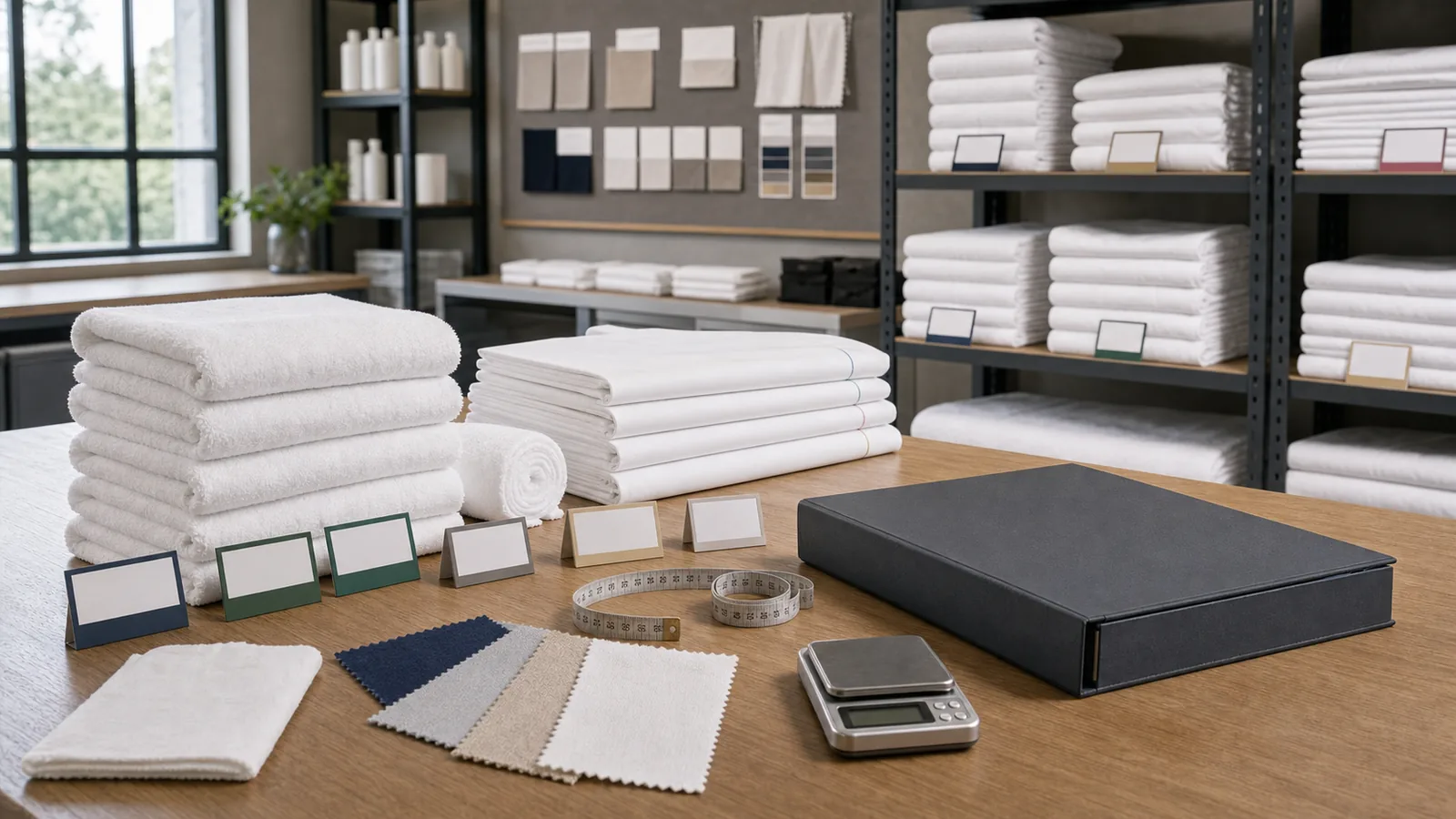
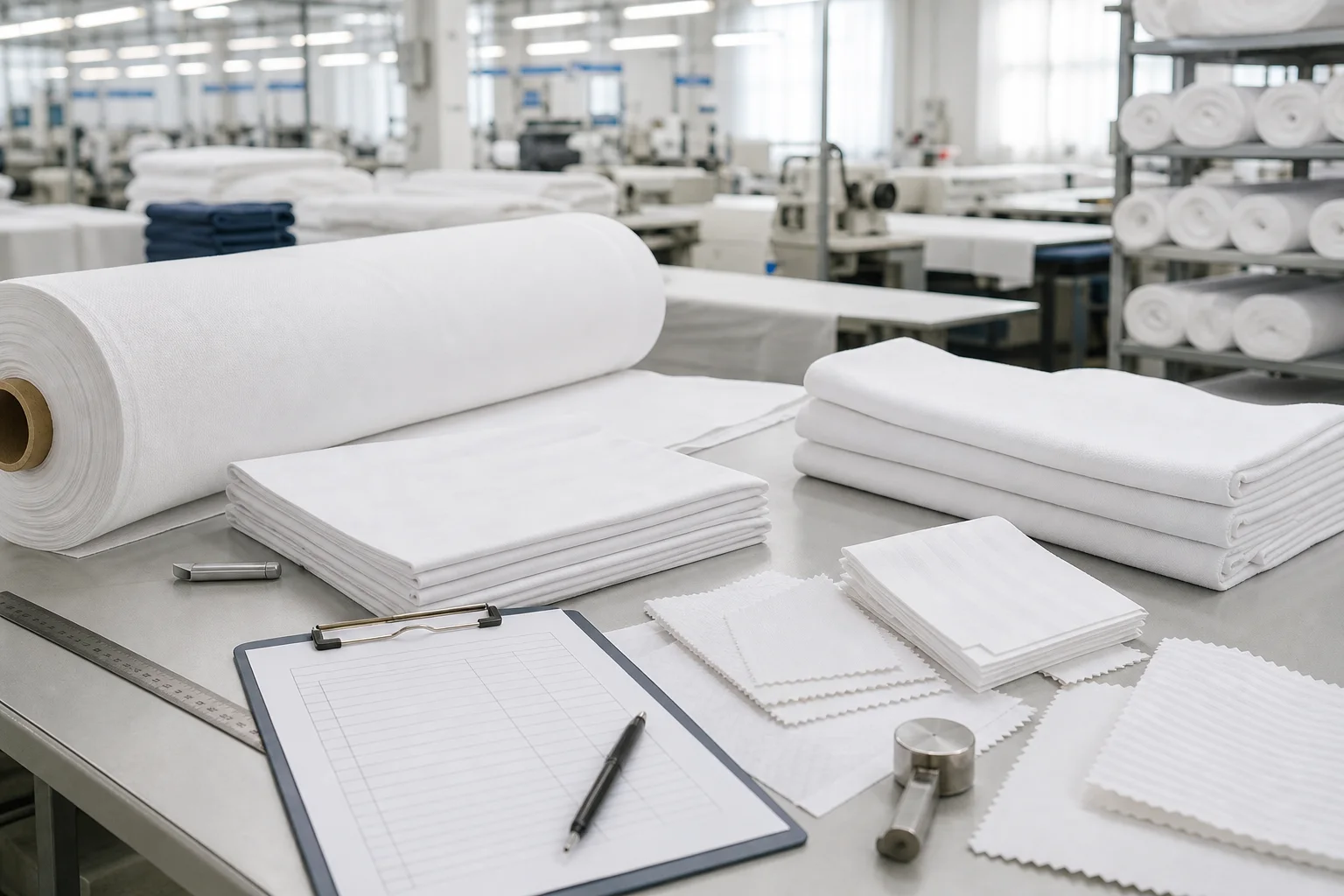
Materials and operations, shown together.
Product detail and back-of-house context help connect each specification choice to how the item looks, launders, stores, or survives service.

Hotel Textile Certifications Explained: OEKO-TEX, GOTS, ISO 9001 & More
When you source bed linen, towels, bathrobes, and table linen for a hotel, the spec sheet is only half the story. The other half is proof: independent evidence that the fabric is safe, that the factory is well run, and that the people who made it were treated fairly. That proof comes in the form of certifications. The trouble is that the landscape is crowded, the acronyms overlap, and plenty of suppliers throw them around loosely. So here is a plain breakdown of what each of the major hotel textile certifications actually verifies, what it does not, and which ones you should insist on for each product you buy.
Key takeaways
- Hotel textile certifications fall into three buckets: product safety (what’s in the fabric), system and process (how the factory operates), and social compliance (how workers are treated). No single certificate covers all three.
- OEKO-TEX STANDARD 100 verifies safety, not sustainability. It confirms a textile is free of harmful substance levels. It says nothing about organic or recycled content.
- GOTS requires certified organic fiber; OEKO-TEX does not. They answer different questions, and you often want both.
- ISO 9001 certifies the factory’s management system, not the fabric itself. It tells you the supplier has consistent processes, not that any specific sheet meets a quality grade.
- For most hotel orders, require OEKO-TEX STANDARD 100 plus a third-party factory audit (Bureau Veritas, SGS, or Intertek). Add GOTS, GRS, or EU Ecolabel only when organic or recycled claims are part of your brief.
Why certifications matter in hotel procurement
A guest never sees a test report, but they feel the consequences of one. Certifications protect you on three fronts at once. First, liability: harmful-substance testing means the linen touching guest skin won’t fail a chemical screen. Second, brand reputation: social-compliance audits keep your supply chain clear of forced labor and unsafe factories, the kind that surface in a journalist’s investigation. Third, procurement risk: a verified supplier audit tells you the factory you’re wiring a deposit to actually exists, operates at the scale it claims, and can repeat the quality on a reorder.
Just as important is knowing what a certificate does not promise. Mistake a safety mark for a sustainability mark, or a process certificate for a product grade, and you end up with specs that read well but fail to deliver what your owner or brand standard actually requires.
Product-safety certifications: what’s in the fabric
OEKO-TEX STANDARD 100
This is the most widely recognized textile-safety certification in the world, and the one to treat as a baseline for any hotel linen. STANDARD 100 means every component of the article (the fabric, the thread, the buttons, the dye, the print) has been tested against a long list of regulated and known-harmful substances, and stays within strict limits. The mark is renewed annually and tightened as new substances get flagged.
OEKO-TEX sorts articles into product classes based on how much skin contact they have:
- Product Class I: articles for babies and toddlers (the strictest limits).
- Product Class II: articles with direct, prolonged skin contact, such as bed sheets, pillowcases, towels, bathrobes, and underwear. This is the class that matters most for hotel linen.
- Product Class III: articles with little or no skin contact, like outerwear and some decorative items.
- Product Class IV: furnishing and decoration materials, including curtains, upholstery fabric, and tablecloths.
When a supplier tells you their sheets are “OEKO-TEX certified,” ask which product class, then ask for the certificate number so you can verify it yourself on the OEKO-TEX label-check tool. Here is the part people miss: STANDARD 100 is about chemical safety, not organic content or environmental impact. A perfectly conventional, non-organic cotton sheet can be STANDARD 100 certified, and it should be.
OEKO-TEX MADE IN GREEN
MADE IN GREEN goes a step beyond STANDARD 100. It is a traceable product label confirming the article was tested for harmful substances and made in facilities audited for environmentally responsible and socially fair conditions. Each label carries a unique ID that lets a buyer trace the production stages. Think of it as STANDARD 100 with a layer of facility-level environmental and social verification on top. It earns its keep when you want a single consumer-facing label that signals both safety and responsible production.
Organic and recycled fiber certifications: what the material actually is
These certifications answer a different question: what is this fabric made of, and can the claim be trusted up the supply chain?
GOTS: Global Organic Textile Standard
GOTS is the leading standard for textiles made from organic fibers. To carry a GOTS label, a product must contain a minimum percentage of certified organic fiber (70% for the “made with organic” grade, 95% for the full “organic” grade). On top of that, the entire processing chain (spinning, weaving, dyeing, finishing) has to meet strict environmental criteria such as restricted chemical inputs and wastewater treatment, plus social criteria based on core labor standards. This is the distinction buyers miss most often: GOTS verifies organic fiber content; OEKO-TEX does not. If your brief calls for genuinely organic linen, the certificate to require is GOTS, not OEKO-TEX.
OCS: Organic Content Standard
OCS is a lighter-weight cousin of GOTS. It verifies and tracks the amount of organic material in a final product, from the raw fiber through to the finished article, using certified transaction documentation. Unlike GOTS, it imposes no environmental processing or social-labor criteria. It is purely a content-tracking and chain-of-custody standard. Reach for it when you need credible proof of organic fiber percentage but don’t need the full GOTS processing scope.
GRS and RCS: recycled content
- GRS (Global Recycled Standard) verifies recycled content and adds environmental processing rules, social criteria, and chemical restrictions. It is, in effect, the recycled-content equivalent of what GOTS does for organics. A product needs at least 20% recycled material to carry the label, and 50% for certain claims.
- RCS (Recycled Claim Standard) verifies and tracks recycled content only. It is the chain-of-custody equivalent of OCS, without the added environmental and social requirements.
For hotel linen made with recycled polyester or recycled-blend fibers, GRS is the more robust claim. RCS is the floor for a credible recycled-content statement.
System and process certifications: how the factory runs
ISO 9001: quality management
ISO 9001 is the most commonly cited certificate in supplier profiles, and the most commonly misunderstood. It certifies the factory’s quality-management system, meaning its processes, not the fabric you receive. An ISO 9001-certified supplier has documented procedures for handling orders, controlling production, tracking defects, and acting on customer feedback, all audited by an external body. That consistency is worth a lot. It’s a strong signal that your sample order and a 5,000-piece reorder will actually match. What it won’t tell you is whether a sheet is a 300-thread-count percale or a towel hits 600 GSM. For that, lean on the product spec and product-safety testing.
ISO 14001: environmental management
ISO 14001 is the environmental sibling of ISO 9001. It certifies that the factory runs a structured environmental-management system, measuring and reducing energy use, waste, water, and emissions against documented objectives, with external audits to back it up. As with ISO 9001, it certifies a system, not a product. It points to an operationally responsible partner, but it says nothing about the organic or recycled content of any specific fabric.
Social-compliance certifications: how workers are treated
amfori BSCI
amfori BSCI (Business Social Compliance Initiative) is an auditing framework for ethical and safe working conditions across a supplier’s operations: fair wages, working hours, health and safety, and no child or forced labor. A BSCI audit produces a graded report (A to E) rather than a simple pass or fail, so ask for the grade and the audit date, not just a claim of participation.
SA8000
SA8000 is a more rigorous, independently certified labor standard built on international human-rights and labor conventions. Where BSCI is an audit program, SA8000 is a full certification of a factory’s social-accountability management system. If your owner or brand runs a strict ethical-sourcing policy, SA8000 is the stronger credential.
Third-party verification: what a “verified supplier” audit means
Bureau Veritas, SGS, and Intertek are the major independent inspection and certification bodies. They don’t issue their own textile standard. Instead, they are the auditors who verify many of the certificates above and who carry out factory and supplier audits. When a supplier is described as “Bureau Veritas verified,” it usually means an independent inspector has visited the facility and confirmed its existence, scale, production capacity, and management systems.
A verified-supplier audit is one of the most practical de-risking tools you have in hotel procurement. It separates a genuine manufacturer from a trading desk reselling under its own name. Always ask which body performed the audit, what scope it covered, and when it was issued. An audit from three years ago is a far weaker signal than one renewed this year.
EU Ecolabel and REACH: the European angle
EU Ecolabel is the European Union’s official environmental label, awarded to products that meet lifecycle-based environmental criteria: restricted substances, reduced water and energy use in production, and fitness-for-use durability tests. For textiles destined for European properties, or for brands marketing an eco position to European guests, EU Ecolabel is a recognized, government-backed signal.
REACH is not a certificate you’ll see on a hangtag. It’s the EU regulation governing the Registration, Evaluation, Authorisation and Restriction of Chemicals. A REACH-compliant textile contains no restricted substances above permitted thresholds. For any linen entering the EU, REACH compliance is effectively mandatory, and it overlaps heavily with what OEKO-TEX STANDARD 100 already verifies. For EU-bound orders, ask suppliers to confirm REACH compliance in writing.
Certifications comparison table
| Certification | What it covers | Applies to | Why a hotel buyer cares |
|---|---|---|---|
| OEKO-TEX STANDARD 100 | Tested free of harmful-substance levels (chemical safety) | The finished product / all components | Baseline guest-safety proof for skin-contact linen |
| OEKO-TEX MADE IN GREEN | Harmful-substance testing + audited facilities | Traceable finished product | Single label signaling safety + responsible production |
| GOTS | Certified organic fiber content + environmental & social criteria | Organic-fiber textiles & their full processing chain | The credible mark for genuine organic linen claims |
| OCS | Organic fiber content tracking only | Organic-content products | Verifies organic percentage without full GOTS scope |
| GRS | Recycled content + environmental & social criteria | Recycled / recycled-blend textiles | Robust proof behind recycled-content marketing |
| RCS | Recycled content tracking only | Recycled-content products | Minimum credible recycled-content claim |
| ISO 9001 | Quality-management system | The factory / organization | Consistency between samples and large reorders |
| ISO 14001 | Environmental-management system | The factory / organization | Operationally responsible manufacturing partner |
| amfori BSCI | Ethical working-conditions audit (graded) | The factory / supply chain | Labor-rights risk screening for your supply chain |
| SA8000 | Certified social-accountability system | The factory | Strongest labor credential for strict sourcing policies |
| Bureau Veritas / SGS / Intertek | Independent factory & supplier verification | The supplier / facility | Confirms a real manufacturer at the claimed scale |
| EU Ecolabel | Lifecycle environmental criteria | The finished product | Government-backed eco signal for EU properties |
| REACH | Chemical-restriction regulatory compliance | Products sold in the EU | Mandatory for EU-bound linen; overlaps OEKO-TEX |
A buyer’s checklist: which certifications to require by product
Use this as a starting framework and adjust it to your brand standard and region:
- Bed linen, pillowcases, towels, bathrobes (direct skin contact): Require OEKO-TEX STANDARD 100, Product Class II as a non-negotiable baseline, plus a third-party factory audit (Bureau Veritas, SGS, or Intertek).
- Curtains, tablecloths, upholstery (low skin contact): OEKO-TEX STANDARD 100 Product Class IV is the relevant class.
- Organic linen programs: Require GOTS rather than just OEKO-TEX, or OCS if you only need verified organic fiber percentage.
- Recycled-content programs: Require GRS for a robust claim, RCS as the minimum.
- Any supplier you’re committing volume to: Require ISO 9001 for process consistency and ask for a social-compliance audit, either an amfori BSCI grade or SA8000.
- EU-bound orders: Confirm REACH compliance in writing; EU Ecolabel is a plus for eco-positioned brands.
- Always: Ask for certificate numbers and issue dates, and verify them on the issuing body’s public registry. A real certificate is verifiable; a screenshot is not.
For the bigger picture on materials, recycled fibers, and lifecycle strategy beyond the certificates themselves, see the sustainable hotel linen guide. To see how these certifications sit alongside fabric construction and weight specs, the bed linen and towel GSM guides cover the product side.
FAQ
What is the most important certification for hotel bed linen? OEKO-TEX STANDARD 100 (Product Class II) is the practical baseline. It confirms the linen is free of harmful-substance levels for direct skin contact. Pair it with a third-party factory audit for supplier reliability.
Is OEKO-TEX the same as organic? No. OEKO-TEX STANDARD 100 verifies that a textile is free of harmful chemicals. It says nothing about organic fiber content. For a genuine organic claim, you need GOTS, or OCS if you only need content tracking.
Does ISO 9001 mean the fabric is high quality? Not directly. ISO 9001 certifies the factory’s quality-management system and processes, which drives consistency between orders. It does not certify any specific fabric’s thread count, GSM, or grade. You still verify those against the product spec.
What’s the difference between GOTS and OCS? Both track organic fiber content, but GOTS also enforces environmental processing rules and social-labor criteria across the whole supply chain. OCS only verifies and tracks the organic content percentage, without those added requirements.
What does “Bureau Veritas verified” mean for a supplier? It generally means an independent inspector has audited the facility and confirmed it’s a real manufacturer operating at the claimed capacity. Ask which body, what scope, and when the audit was issued. Recency matters.
Do I need EU Ecolabel or REACH for hotels outside Europe? REACH compliance is mandatory only for textiles sold into the EU, though it overlaps with what OEKO-TEX already verifies. EU Ecolabel is optional everywhere and most relevant for European properties or brands marketing an eco position to European guests.
Internal links: sustainable-hotel-linen-guide, how-to-choose-hotel-bed-linen, hotel-towel-gsm-buying-guide
Sourcing certified hotel linen and supplies for a new property or a refurbishment? A good starting point is to ask any hospitality textile supplier for current certificate numbers, a product catalog, and fabric samples you can verify and test yourself. Request a custom quote alongside the documentation, so you can match certifications to each product line before you commit.