Hotel Bathrobe Guide: Waffle, Velour & Terry
Choose hotel bathrobes by fabric and property type. Compare waffle, velour, terry & microfiber robes, GSM, sizing, branding and laundering.
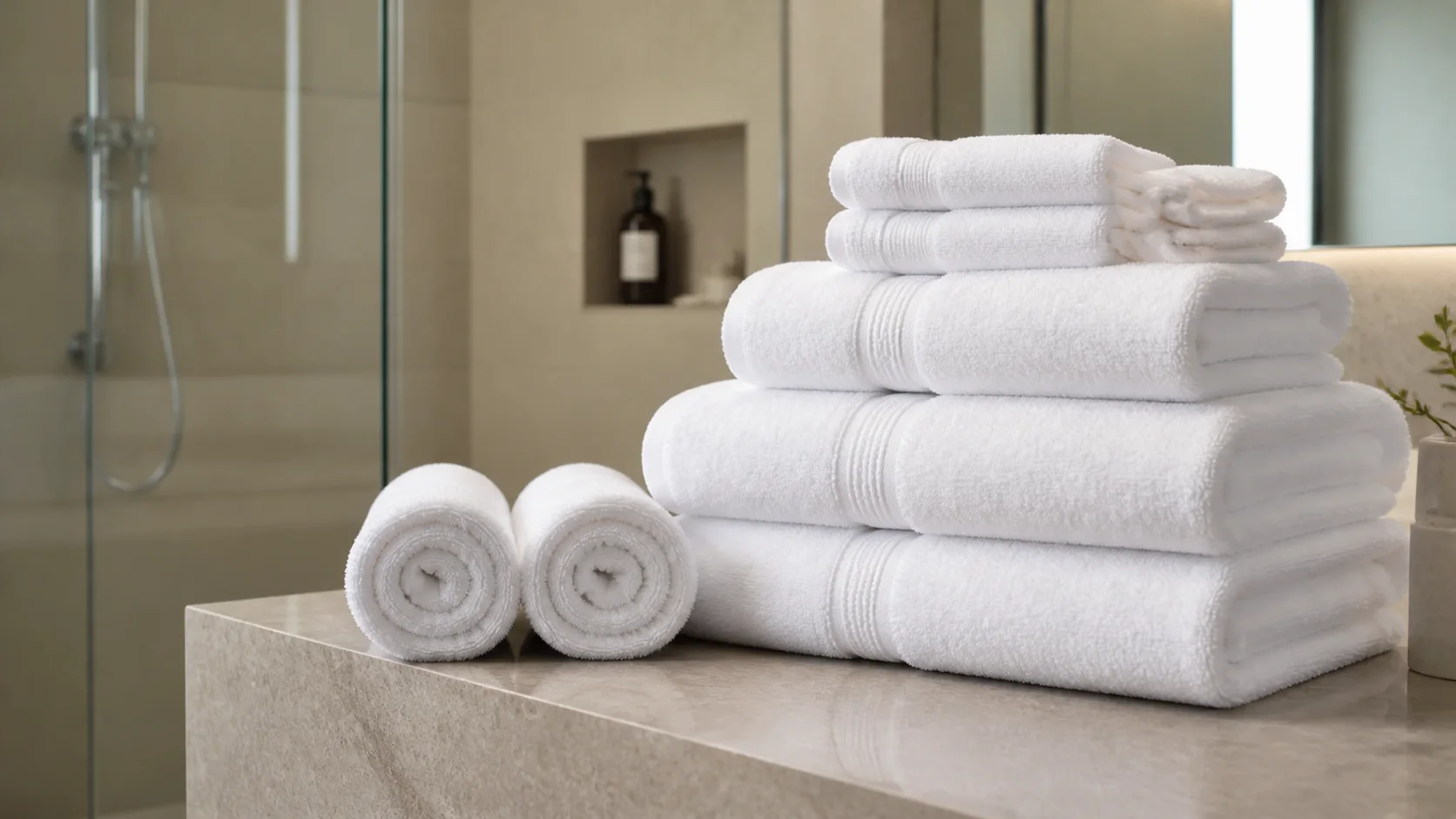
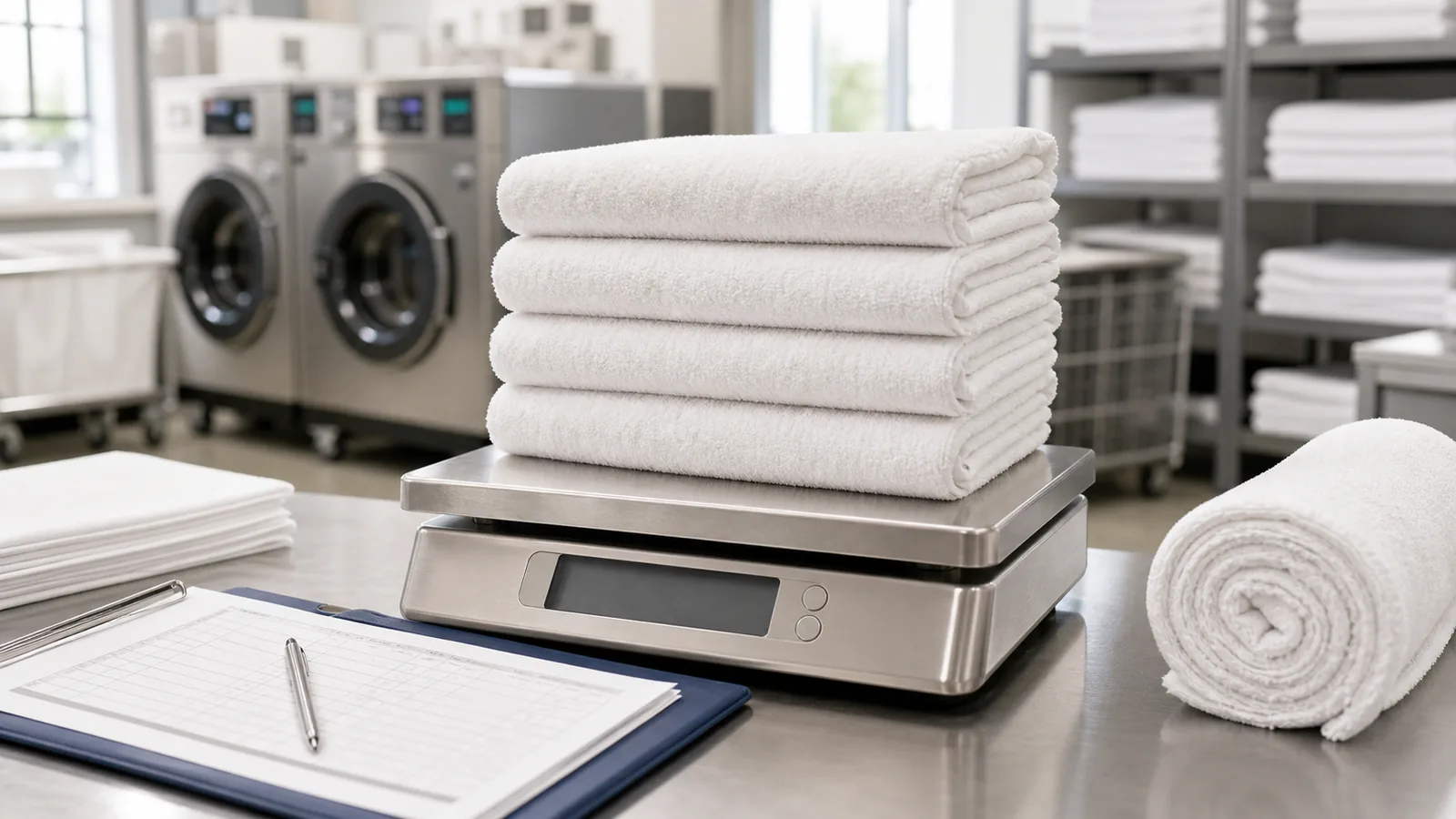
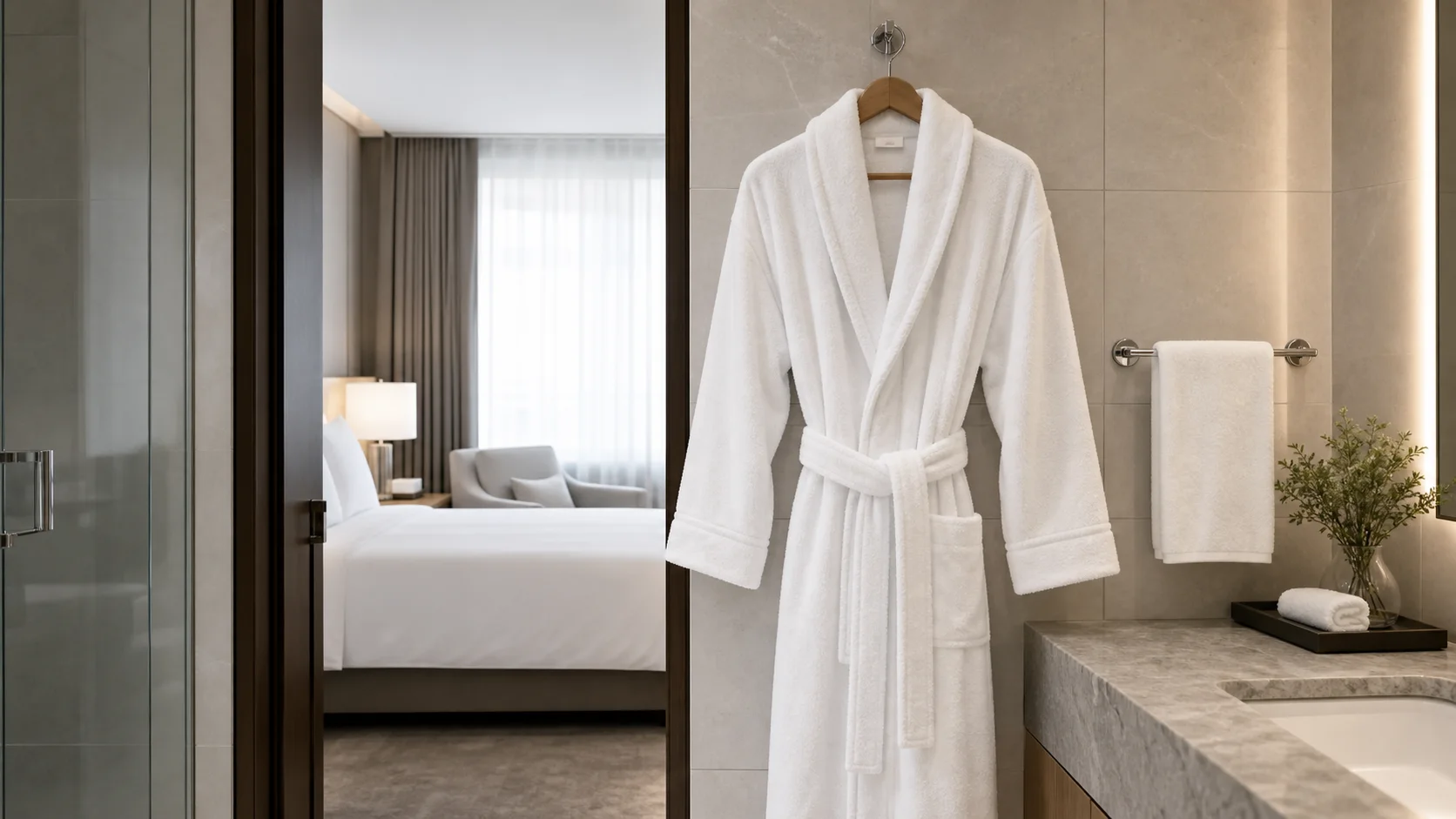
Materials and operations, shown together.
Product detail and back-of-house context help connect each specification choice to how the item looks, launders, stores, or survives service.
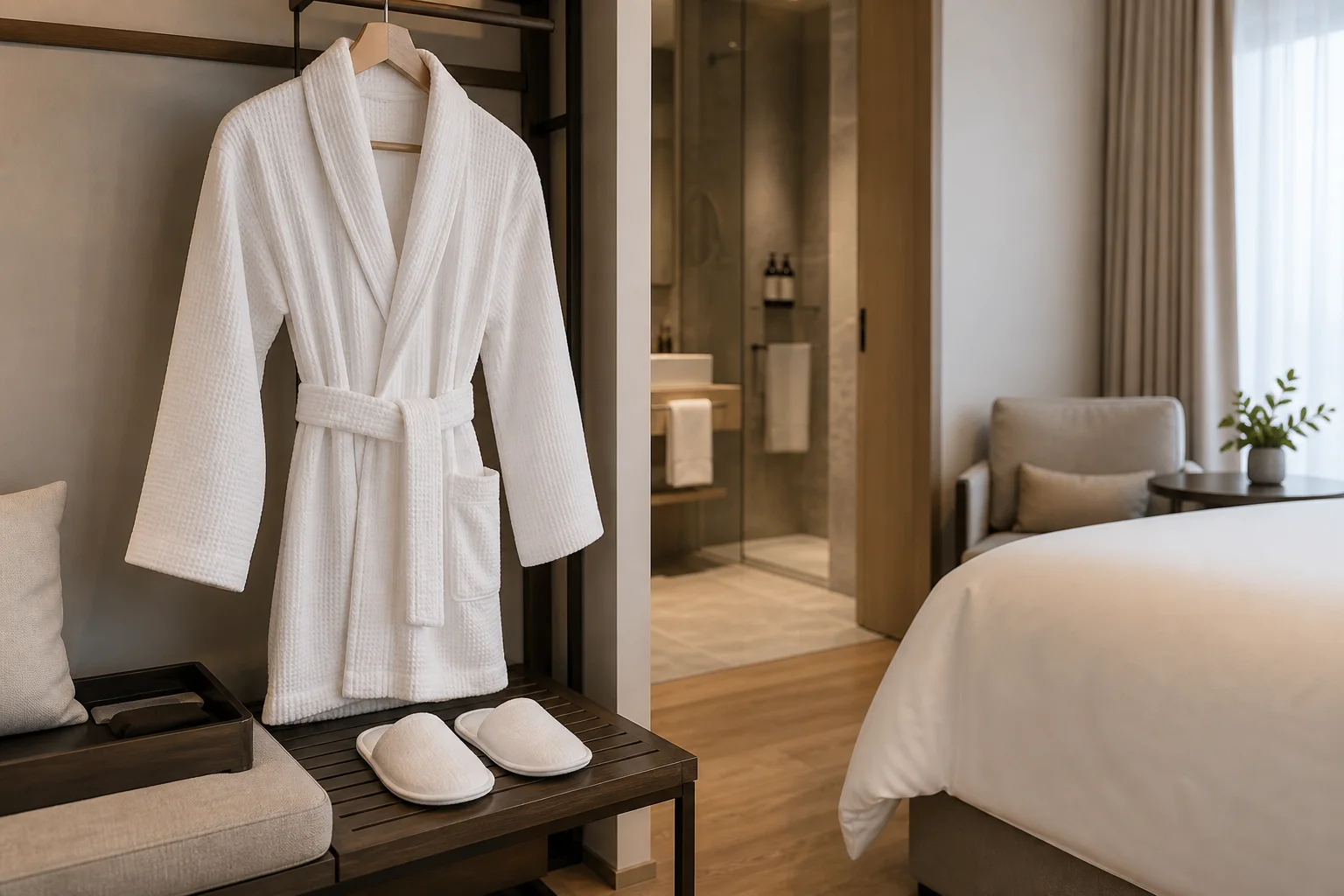
Hotel Bathrobe Guide: Waffle, Velour & Terry by Property Type
A bathrobe is one of the few amenities a guest actually wraps around themselves, so it carries an outsized share of the quality verdict. Get it right and it reads as effortless luxury. Get it wrong and it feels scratchy, thin, or slow to dry. This guide walks procurement teams through the main robe fabrics, the weight and sizing calls behind them, branding and construction details, and how to match each style to your property type. We’ll keep the focus on robes, with a quick note on coordinating slippers, and point you to a dedicated towel resource for the deeper fabric-weight science.
Key takeaways
- Match fabric to setting: terry and velour suit spas and luxury suites; waffle suits warm-climate resorts and poolside; microfiber and coral fleece serve budget and warmth-first programs.
- Lighter isn’t always cheaper-feeling: waffle robes are deliberately light and quick-drying, while terry and velour trade weight for plushness and absorbency.
- Stock smart on sizing: one-size-fits-most kimono robes simplify par stock, while S/M/L/XL shawl-collar robes improve fit for premium and resort programs.
- Construction details drive durability: reinforced belt loops, double-stitched pockets, and a hanging loop extend commercial reuse and survive industrial laundering.
- Branding is a quiet differentiator: subtle tonal embroidery on the chest or cuff signals quality without shouting.
Why bathrobe selection deserves real attention
Robes are a high-touch, high-visibility item with a punishing service life. Unlike a decorative cushion, a hotel bathrobe gets worn wet, laundered hot, tumble-dried, and rotated dozens of times a month. A bad choice shows up fast as pilling, graying, flattened pile, or frayed belt loops. A good one holds its hand-feel and color through hundreds of wash cycles, keeps the brand impression clean, and makes replacement costs predictable.
Three questions frame nearly every robe decision:
- Where is it used? A poolside cabana, a spa treatment room, and a city suite all have different absorbency, weight, and drape priorities.
- Who launders it? In-house and outsourced commercial laundries both reward robes built for repeated high-temperature processing.
- What does it need to say? A wellness resort wants enveloping plush. A design-led business hotel may want crisp, lightweight minimalism.
The main hotel bathrobe fabrics
Terry / towelling robes
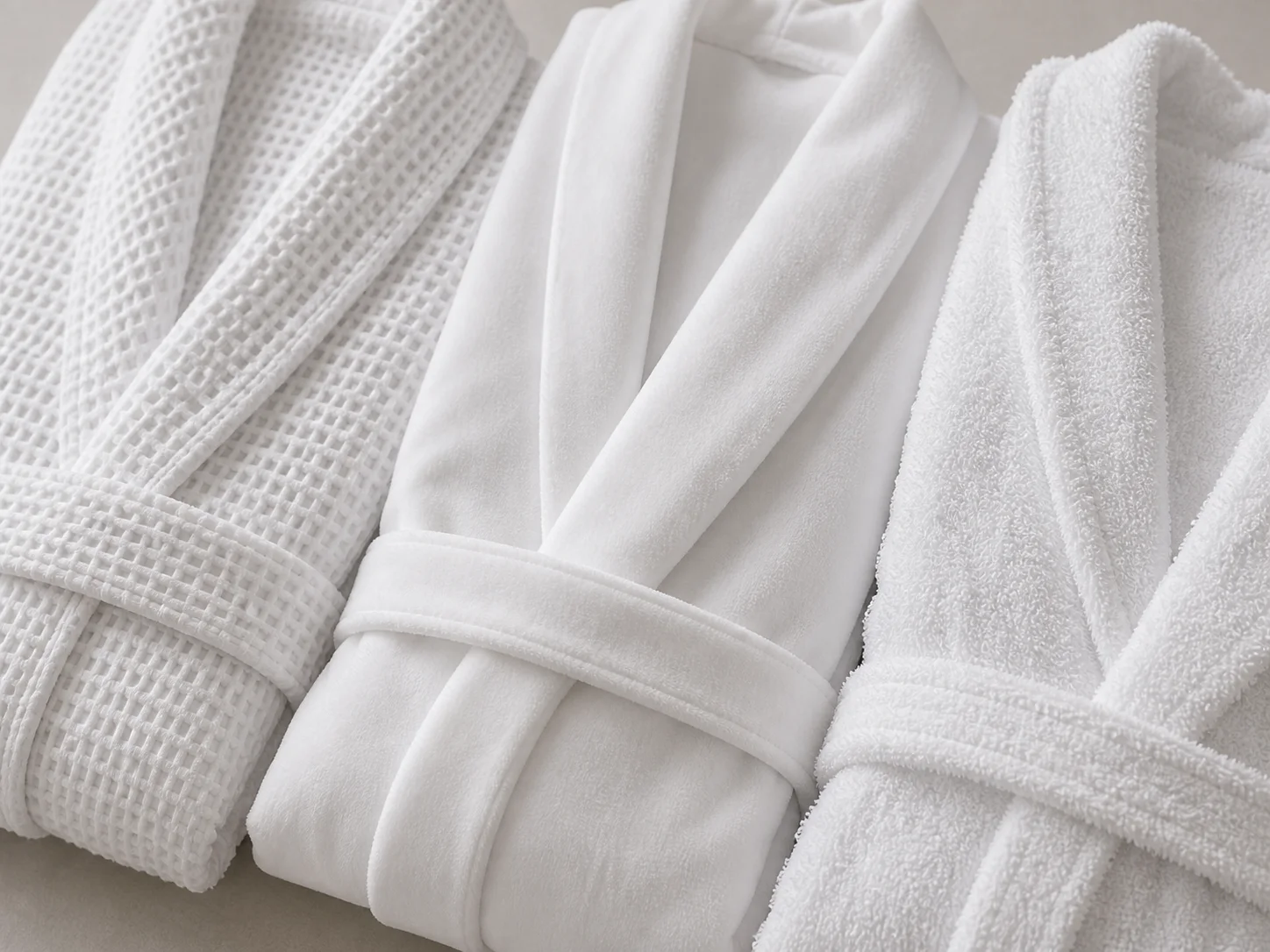
Terry (looped towelling, usually cotton) is the workhorse of hotel robes. The same absorbent loop structure that defines a good towel makes terry robes excellent at pulling moisture off the skin, which is why they dominate spa, pool, and wellness settings. They feel substantial and reassuringly absorbent. The trade-offs are weight and dry time. A heavy terry robe is gloriously plush, but it’s slower to dry and heavier to launder in volume. Typical robe weights run roughly 300 to 450 GSM for everyday programs, and higher for premium spa robes.
Velour robes (terry-back, velour-face)
Velour robes are typically terry on the inside (for absorbency) with the outer loops sheared to a smooth, velvety face. The result is a plush, refined look that photographs beautifully and feels indulgent against the skin, which makes it a natural fit for luxury suites and turndown service. You keep most of terry’s absorbency on the inner face while gaining a softer, more polished exterior. Velour robes sit at the heavier, more premium end, so expect a higher price and slightly more careful laundering to protect that sheared face.
Waffle / honeycomb robes
Waffle (honeycomb weave) robes are the lightweight specialists. The textured weave traps air, so they feel warm for their weight, breathe well, and dry quickly. That last point is a real advantage in humid climates, beach resorts, and high-turnover spa cabanas. They pack flat, launder efficiently, and carry a clean, contemporary look that suits design-forward and boutique properties. They’re less plush and less instantly absorbent than terry, so they read as light and crisp rather than enveloping. Some properties offer a waffle/terry hybrid (waffle face, terry lining) to split the difference.
Microfiber and coral fleece robes
Microfiber and coral fleece (polyester-based) robes prioritize warmth, softness, and budget. Coral fleece in particular feels cozy and is popular for cooler climates, residences, and value-tier programs. They’re lightweight and quick-drying, but less breathable and less naturally absorbent than cotton terry, and some guests read synthetics as less premium. They can still be a smart fit when warmth or cost comes first, or when you want a soft loungewear feel rather than spa absorbency.
Robe-fabric comparison table
| Fabric | Feel | Absorbency | Dry time | Warmth | Best for |
|---|---|---|---|---|---|
| Terry / towelling | Plush, substantial | High | Slower | Medium to high | Spa, pool, wellness |
| Velour (terry-back) | Smooth, velvety, premium | Medium to high | Slower | Medium to high | Luxury suites, turndown |
| Waffle / honeycomb | Light, crisp, textured | Medium | Fast | Medium (warm-for-weight) | Resorts, poolside, warm climates |
| Microfiber / coral fleece | Soft, cozy | Low to medium | Fast | High | Budget tiers, cool climates, residences |
Cuts and collars: kimono, shawl, and hooded
Fabric is half the decision; cut is the other half.
- Kimono (flat-collar) robes have a simple wrapped front with no rolled collar. They’re clean, modern, easy to fold, and naturally unisex, so one design serves every guest and par stock stays simple. A strong default for waffle robes and lean operations.
- Shawl-collar robes feature a rolled, draped collar that reads as classic luxury. They feel more substantial and tailored, which makes them the go-to for premium terry and velour programs.
- Hooded robes add warmth and a relaxed, residential feel. They suit pool and beach resorts, spa cooldown areas, and family or residence properties, though the hood adds fabric, weight, and laundering bulk.
GSM, sizing, and unisex design
Weight (GSM). For robes, GSM is a feel-and-function lever, not just a quality score. Lighter waffle robes are a feature, not a compromise, and heavier terry and velour robes deliver plushness and absorbency. Don’t chase maximum weight for its own sake. Match it to climate, use, and laundry capacity. For the deeper science of fabric weight and absorbency, see our dedicated towel guide linked below.
Sizing strategy. You have two broad paths:
- One-size-fits-most: Usually a generously cut unisex kimono robe with a long belt. It dramatically simplifies par stock, storage, and housekeeping, and works well for most city and mid-scale programs.
- S/M/L/XL stocking: Better fit and guest comfort, especially valued at resorts, spas, and luxury properties. It improves the experience, but it adds SKUs, storage complexity, and par-stock planning.
Unisex design keeps colors neutral (white, ivory, gray, taupe), uses a balanced cut, and skips gendered styling. It’s the practical default for most hotel robe programs.
Construction and branding details that matter
Small details separate a robe that survives commercial life from one that frays in a season:
- Belt and belt loops: A securely attached belt with reinforced, double-stitched loops at the waist. Keep a spare-belt buffer in par stock, because belts are always the first thing to go missing.
- Pockets: One or two patch pockets with reinforced top corners. Useful for guests and a quiet quality cue.
- Hanging loop: An interior neck loop so robes hang neatly on hooks and dry evenly. Small touch, real operational value.
- Seams and stitching: Flat, even seams and double-stitched stress points hold up to repeated industrial washing.
Branding options. Robes are an elegant branding canvas. Embroidery on the left chest or cuff is the most durable and upscale option. Tonal (same-color) embroidery signals refinement, while contrast thread makes the logo pop. Woven or printed neck labels are a lower-cost alternative. Keep logos modest, because restraint reads as luxury. For multi-property groups, consistent placement across every robe builds a cohesive brand impression.
Laundering and durability for commercial reuse
Hotel robes live or die by their laundering performance. Build your program around it:
- Color choice: White robes stay bright with the right laundering, but they show stains. Deeper neutrals hide marks and can ease the laundry burden. Confirm colorfastness on any dyed robe.
- Fabric realities: Cotton terry and velour reward proper drying and dosing, and over-drying flattens the pile and shortens its life. Sheared velour faces want gentler handling. Waffle and synthetic robes generally take high turnover in stride and dry fast, which lowers energy and time costs.
- Shrinkage and pre-treatment: Ask suppliers about pre-shrinking and how robes are expected to behave after the first several industrial cycles.
- Par stock: Plan enough rotation (in-use, in-laundry, in-reserve) so robes are never forced through aggressive express cycles that wear them out early.
Fabrics and constructions built for repeated high-temperature processing are the single biggest driver of lifetime cost. A slightly higher upfront spend on a robe engineered for commercial reuse usually beats a cheap robe you replace twice as often.
Don’t forget coordinating slippers
Slippers complete the in-room or spa experience and are a natural companion purchase to robes. The common formats are:
- Closed-toe waffle or terry slippers that visually coordinate with the robe program.
- Open-toe (peep-toe) slippers for warm climates and spas.
- Coral fleece or plush slippers for cozy, cooler-climate or residence settings.
The key decisions mirror robes: disposable versus reusable (washable) slippers, anti-slip soles for wet areas, and whether to brand the strap or insole. Coordinate the slipper fabric and color with the robe and the whole turndown or spa presentation looks polished and intentional.
Mapping fabric to property type
- City / business hotel: Lightweight waffle or mid-weight terry kimono robes, one-size-fits-most, neutral and crisp. Easy to launder and store.
- Resort / spa: Terry for absorbency, or waffle in humid, warm climates. Consider hooded cuts and S/M/L/XL sizing for guest comfort.
- Poolside / beach: Waffle wins here. It’s light, breathable, fast-drying, and quick to turn around between guests.
- Luxury suites / turndown: Velour or premium heavy terry with shawl collars and subtle tonal embroidery for an indulgent, photogenic finish.
FAQ
What is the best fabric for hotel bathrobes? There’s no single best fabric. It depends on use. Terry and velour suit spas and luxury suites for absorbency and plushness, waffle suits warm-climate resorts and poolside for its light, quick-drying feel, and microfiber or coral fleece suits budget and warmth-first programs.
What is the difference between waffle and terry hotel robes? Terry is looped towelling that is more absorbent, plush, and heavier but slower to dry. Waffle is a textured honeycomb weave that is lighter, breathable, and dries quickly, making it ideal for humid climates and high-turnover settings, though it feels less plush.
What GSM should a hotel bathrobe be? Robe weight is a feel-and-function choice rather than a strict quality score. Everyday terry robes often sit around 300 to 450 GSM, with premium spa and velour robes heavier, while waffle robes are deliberately lighter. Match weight to climate, use, and laundry capacity.
Should hotel bathrobes be one-size-fits-most or sized S to XL? One-size-fits-most unisex kimono robes simplify par stock and storage and work well for most city and mid-scale hotels. Stocking S/M/L/XL improves fit and comfort and is worth the added SKUs for resorts, spas, and luxury properties.
Can hotel bathrobes be branded with a logo? Yes. Embroidery on the chest or cuff is the most durable and upscale option, with tonal thread for subtle refinement or contrast thread for visibility. Woven or printed neck labels are a lower-cost alternative. Keep logos modest for a premium look.
How long do commercial hotel bathrobes last? Lifespan depends on fabric, construction, and laundering more than any single number. Robes built for commercial reuse (reinforced belt loops, double-stitched seams, colorfast fabric) and laundered correctly with adequate par-stock rotation last far longer than cheap robes pushed through aggressive cycles.
Internal links: hotel-towel-gsm-buying-guide, hotel-textile-certifications-explained, sustainable-hotel-linen-guide
Ready to refine your robe and slipper program? Request fabric samples to feel the difference between waffle, terry, and velour in person, or ask a hospitality supplies partner for a product catalog and a custom quote tailored to your property type and laundry setup. The right robe is a small line item that quietly shapes how guests rate their stay.